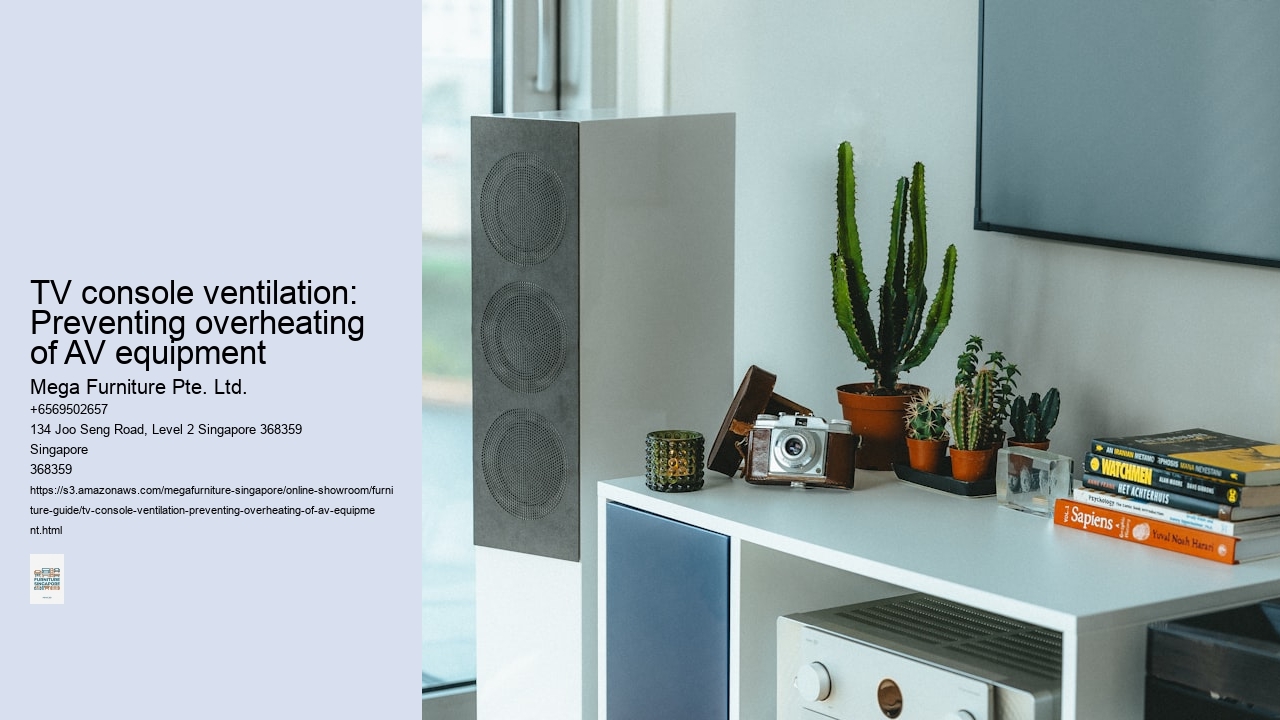
The PlayStation 5 you bought for the kids will, within a year, likely become the single hottest object in your four-room BTO living room. That’s not an exaggeration — combine its heat output with an AV receiver and a set-top box, and you’re looking at a closed cabinet that’s essentially a small, expensive oven. Singapore’s year-round 80% humidity compounds the problem, creating a perfect storm for condensation to form on cold internal surfaces and for heat to have nowhere to go. This is why the design of your TV console’s rear panel matters more than you think. Many ready-made units arrive with a solid backboard, which is fine for a bedroom sideboard but a death sentence for modern electronics. You’ll want rear ventilation slots, or ideally a completely open back, to allow that trapped hot air to escape directly into the room rather than swirling around your components. It’s a non-negotiable for any console destined to house a PS5 or similar; that heat has to go somewhere. Open shelving or perforated doors offer another layer of defence. They promote passive airflow across the front of your equipment, preventing hot spots from building up. In many newer BTO layouts, the console bay is a built-in alcove that’s enclosed on three sides — here, a cabinet with solid sides and doors becomes a thermal trap. A unit with a mesh or slatted front, or even just a few open display cubbies flanking the central storage, can make a significant difference to internal temperatures. The goal isn’t just to avoid a meltdown; it’s to prevent the slow degradation that comes from constant overheating. You might not notice the damage until your receiver starts cutting out on movie night or the console fan develops a permanent, frantic whine. It’s a practical consideration that often gets lost amidst the search for the right finish or length, but overlooking it can quietly shorten the lifespan of gear that cost far more than the furniture itself. For a selection that includes designs mindful of this, you can browse the
TV console range at Megafurniture, where options with adequate rear ventilation are clearly detailed.
That solid rubberwood console from a drier climate will likely bow within a year in a north-facing Bedok flat. Singapore's humidity doesn't just feel heavy; it physically pulls moisture into untreated wood fibres, causing panels to swell and joints to crack. Engineered wood with a proper moisture-resistant laminate provides a far more stable core, its layers glued in opposing directions to counteract natural movement. It’s a concession, perhaps, for purists who love solid timber, but it’s the practical choice for longevity. The finish matters just as much—look for a thermally fused laminate that seals every edge completely, preventing vapour ingress at the seams.
While less common in high-rise flats, subterranean termites remain a genuine concern for ground-floor units and landed homes nearby places like Tampines. Metal legs aren't just a mid-century modern aesthetic; they create a physical barrier that pests simply cannot consume. Powder-coated steel or aluminium bases lift the main cabinet body away from potential ground contact, a simple but effective strategy. Even consoles with wooden frames should have these critical contact points reinforced or capped with metal. It’s a one-time specification that removes a lifetime of worry.
Porous materials like unsealed cane, certain natural stones, or some open-grain woods act like sponges in our climate. They’ll absorb ambient moisture, leading to mildew stains and a perpetually damp feel that can even affect electronics stored inside. Opt for sintered stone, high-pressure laminates, or properly sealed lacquered finishes that offer a non-absorbent, wipe-clean surface. This is especially critical for the top surface, which endures spills from drinks and condensation from air conditioner units—a common, silent source of water damage many overlook.
Sturdy construction isn't about sheer weight; it's about how the piece handles the constant push-and-pull of family life. Check for reinforced corner blocks, dowelled or mortise-and-tenon joints rather than just staples or basic screws. A well-built console should feel solid when you gently rock it from corner to corner, with no audible creaks or flex in the back panel. This rigidity is what prevents doors from sagging on their hinges after hundreds of openings and ensures drawers keep sliding smoothly, even when packed with game controllers and charging bricks.
Consider the real load: a 75-inch TV, two soundbars, a PlayStation, and a pile of board games create concentrated pressure points. Particleboard shelves will eventually bow under this without proper central support. Look for consoles with thick shelf panels, ideally 18mm or more, and vertical dividers or centre legs running front-to-back to distribute weight. Run your hand along the span of any open shelf in the showroom; if you detect a dip already, imagine it after two years in your 4-room BTO. That’s where the engineering truly proves itself.
The sealed, full-height cabinet looks sharp in the showroom, a monolithic block of lacquer behind a 75-inch screen. It’s a popular choice for BTO feature walls, promising a clean, minimalist look. That aesthetic comes at a cost, however, as solid back panels and doors trap heat from the AV receiver, PlayStation, and set-top box—turning that sleek cabinet into a small oven that can throttle performance and shorten component lifespans. Ventilation isn't a luxury; it's a requirement for any electronics enclosure, and sacrificing it for a seamless front is a trade-off that often leads to regret.
Another frequent oversight is cable management in new BTO walls. Buyers will painstakingly chase walls for conduit to hide HDMI and power cables, creating that coveted flush-mount look for the television. Yet they’ll completely neglect to plan an accessible path for the fibre optic terminal and router ports, which are invariably located in a far corner of the living room. The result? A beautiful, cable-free wall marred by a single, stubborn white cable snaking 4 metres across the skirting to the console, because nobody thought to run a separate data conduit during renovation.
Then there’s the simple mistake of trusting a floor plan instead of a tape measure. A 240cm console might fit the 250cm wall on paper, but it ignores the 10cm door frame on one side or the air-conditioning trunking on the other. In a typical 4-room BTO layout, the living room feature wall is often interrupted by a bedroom entrance or a structural column; buying a console that stretches wall-to-wall can block a door’s swing or look awkwardly crammed. The console should complement the room’s proportions, not fight them.
Practical access is routinely forgotten, too. People will secure a floating console tightly to the wall, admiring its weightless look, only to realise they need to contort themselves like a mechanic to plug in a new HDMI cable or reset the router’s power. Leaving some rear clearance or specifying a removable back panel isn’t glamorous, but it’s the difference between a setup that’s functional for its decade-long lifespan and one that’s a permanent frustration. Good design accommodates real life, not just a photographer’s first visit.
A spec sheet can’t tell you if a drawer will stick after a year of Singapore’s humidity, or if a veneer finish feels plasticky under your hand. That’s the main reason to make the trip to a showroom like Megafurniture’s at Joo Seng or Tampines: you’re there to assess the physical reality of a piece before it becomes a permanent fixture in your 4-room BTO living room. You can visually check the rear ventilation cut-outs—are they large enough for your PS5’s exhaust, or just decorative slits? Run a finger along the sintered stone top to feel the seam, and test the weight of a solid rubberwood door versus a laminate one. Focus on the mechanics. Open and close every drawer a few times; the glide should be smooth and silent, without any wobble or immediate resistance. Check the door alignment on wall-mounted units—they should sit flush without you having to adjust the hinges. This hands-on inspection reveals build quality that online photos often gloss over, especially for consoles in the $1,200 to $2,400 range where expectations are higher. Seeing the full range of lengths, from 120cm to over 240cm, laid out in a showroom space also gives you a much better sense of proportion than a website slider. What looks modest online can dominate a narrow HDB layout, while a longer console might finally solve the storage chaos around a 75-inch TV. It’s about visualising the actual footprint in your own space. Finally, the staff on site can answer specific, technical questions that go beyond basic assembly. If you’re planning a complex AV setup with a soundbar, multiple gaming consoles, and a NAS drive, they can clarify what’s possible in terms of custom cable management holes or adjusting internal shelf heights. It’s a direct conversation about your needs, which often saves more time than a week of online research. You can explore their available options on the
TV console collection pageto shortlist models before your visit.
A console arriving on a Friday evening only to scrape the lift doorframe is a uniquely Singaporean frustration. Confirm your HDB’s lift landing dimensions before ordering anything over 200cm; that sleek 240cm teak unit might demand a costly crane lift from the void deck if it can’t make the turn. Evening or weekend delivery slots aren’t just a convenience—they’re essential for working residents in Bishan or Punggol who can’t take a half-day off to receive furniture.
Professional assembly is non-negotiable for a piece this large and low. A two-person team will properly distribute the weight during positioning, preventing scratches or dents on new vinyl plank or engineered timber flooring—damage that’s glaringly obvious in a sparsely furnished BTO living room. They’ll also ensure the unit is perfectly level on an uneven floor, a common issue in older resale flats, which prevents wobbling under the weight of a 75-inch TV.
Scrutinise the warranty for specifics on our climate. A one-year guarantee is the baseline, but you need coverage for humidity-related issues like wood swelling, joint failure, or veneer peeling. Many standard warranties only cover outright manufacturing defects, not environmental stress; given Singapore’s constant 80% humidity, that’s a critical distinction. Keep your delivery note and assembly receipt filed, as you’ll need them for any claim.
Finally, consider the unpackaging. A large console generates a staggering amount of cardboard and polystyrene; some retailers include removal, while others leave it for you to break down. It’s a minor point until you’re facing a mountain of packaging in your 4-room flat’s common corridor on collection day. Planning for the entire lifecycle, from delivery truck to eventual disposal, saves more headache than you’d think.
The questions in your head while scrolling through product photos at 11pm are the real ones — they’re about weight limits, pet claws, and that specific HDB wall. Here are the concrete answers.
Can a wall-mounted console hold my 55-inch TV and soundbar? It absolutely can, provided you follow two rules. First, check the console’s stated weight capacity — it must exceed the combined weight of the TV, soundbar, and any other gear you’ll place on it. Second, and more critical, you must mount it into solid concrete or properly secured studs; those plasterboard walls in older flats won’t cut it. The mounting hardware supplied is often generic, so for peace of mind in a 4-room BTO, consider upgrading to heavier-duty wall anchors from your local hardware shop.
What’s the best material for homes with pets? You’ll want something that resists scratches and is easy to wipe down. Laminated MDF or melamine finishes are practical and budget-friendly, hiding light scuffs from claws. For a more premium look that can take a beating, sintered stone or quartz composite tops are excellent — they’re virtually impervious to scratches and stains from spills. Avoid soft, oiled woods or veneers that show every mark; if you love the wood look, opt for a harder, lacquered finish like oak or walnut.
How do I cool a closed cabinet with a PS5 inside? You can’t rely on passive ventilation here; you need to actively move air. The simplest solution is to install a pair of quiet USB-powered exhaust fans at the rear of the cabinet, creating a steady airflow that pulls hot air out. Always keep the cabinet doors open during extended gaming sessions, and never place the console in a fully enclosed cubby without any rear clearance — that’s a recipe for thermal throttling and a shortened lifespan for your gear.
What console depth works for a standard HDB living room TV distance? In most HDB layouts, where you’re sitting around 2.5 to 3 metres from the screen, a console depth of 40 to 50cm is the sweet spot. It provides enough surface for a soundbar without jutting too far into the walkway, and it offers sufficient internal cabinet depth for AV receivers and game consoles. Going shallower than 35cm often means you’ll struggle to fit standard components, forcing you to leave them on the floor — which rather defeats the purpose of buying a console for organisation. For a wider selection of sizes and styles that fit these parameters, you can browse the options at Megafurniture.
The console arrives, you unpack it, and then you realise the power point is behind the left leg, not the centre. You’ll need to shift everything. That’s why measuring your wall isn't just about length; it’s about mapping your outlets. In a 4-room BTO living room, the socket placement is often fixed, so a 180cm console might leave your router stranded if you don't account for it. Centre your measurements on the plug, not the wall.
Verify the rear panel before you commit. Many modern consoles have a solid back board for stability, which traps heat from your PlayStation or media player. Look for models with dedicated cable holes or a perforated design; a few strategic vents can prevent that familiar warm hum from building up behind a closed door. It’s a small detail that becomes obvious only when your equipment starts throttling.
Weight capacity is rarely advertised, but it’s critical for those stacking a soundbar, a centre speaker, and a heavy OLED TV on the top shelf. A console built from solid rubberwood or with reinforced internal framing can typically handle 50 to 80kg distributed across its surface. A sintered stone top adds stability, but check the underlying structure—that’s where the support actually lives.
Finish choice feels like a style decision, but in a space with existing laminate flooring or tile, it becomes a cohesion one. A walnut-toned console against light grey HDB tiles can look disconnected; a matte black or white oak finish often bridges the gap better. Plan your cable routing before assembly, too. A quick sketch of where the HDMI and power cables will run—through internal channels or out the back—saves you from the spaghetti junction visible from your sofa.
That final check is about avoiding the three-day reassembly project. It’s worth the extra hour.
In a typical 4-room BTO, the living room's three-metre depth dictates everything. A TV console anchors the wall opposite the sofa in the same way a tall bookshelf anchors a corner — long horizontal piece, mix of open and closed storage, defines the visual weight of one whole side of the room. Megafurniture's TV Console range covers floating wall-mounted designs, low-profile freestanding consoles, and modular feature-wall configurations. Most pieces sit at 40-50cm height, sized for screens up to 75 inches.. You'll measure twice, buy once, and still find the 65-inch TV you bought during the GSS dominates the entire wall. That's why console length isn't just an aesthetic choice-it's a spatial negotiation, where a 65-inch screen demands a cabinet of at least 180 centimetres to avoid a comically undersized plinth. The mismatch is glaring in HDB layouts, where every centimetre from the feature wall to the opposite sofa feels accounted for. Condo feature walls and landed home media rooms present different challenges. A condo's built-in bulkhead often forces a floating console solution, while a landed property's dedicated theatre room might accommodate a full 240-centimetre unit for a 75-inch screen. The principle remains: console length must visually anchor the TV's width, or the whole wall composition feels unstable. It's a proportional rule that many buyers overlook until the delivery team is hauling the box upstairs. A Bookshelf earns its place in Singapore homes through dual function — book and decor storage in the open shelves, soft visual division when placed mid-room in open-plan condominium layouts. Megafurniture's combined display unit and bookshelf hub covers tall book racks, cubby-hole designs, ladder shelves, modular cube systems, and glass-door pieces in oak, walnut, and MDF veneer finishes. Solid-wood pieces typically start around $425, with most heights spanning 120cm to 220cm to fit standard 2.6m HDB ceilings.. Placement demands are equally pragmatic. Wall-mounted or floating consoles free up precious floor space in compact 85 sqm flats, making mopping around the unit straightforward-a small but daily luxury. For families, a floor-standing design with integrated cable management hides the inevitable tangle of PlayStation cords and charger wires, keeping the living area looking organised despite the chaos of daily life. The choice often comes down to whether you prioritise easy cleaning or maximum concealed storage. Display cabinets sit between bookshelf and storage cabinet in function — closed glass-front protection for the items you want visible but not collecting dust. Megafurniture's Storage Cabinet range covers glass-front, curio, wall-mounted, and freestanding configurations in solid wood, MDF, and metal-framed constructions. Average pricing for glass-front variants sits around $271, with LED-lit and motorised-shelf models commanding the higher tier.. Ultimately, your housing type steers the decision. An HDB resale flat with a deep living room might allow for a substantial media unit, but a shoebox apartment's layout necessitates a floating, space-saving design. It's worth browsing the
TV console rangewith your room's specific dimensions and your TV's size in hand; a console that's too short makes even a premium television look like an afterthought.
In a typical 4-room BTO, the living room’s three-metre depth dictates everything. You’ll measure twice, buy once, and still find the 65-inch TV you bought during the GSS dominates the entire wall. That’s why console length isn’t just an aesthetic choice—it’s a spatial negotiation, where a 65-inch screen demands a cabinet of at least 180 centimetres to avoid a comically undersized plinth. The mismatch is glaring in HDB layouts, where every centimetre from the feature wall to the opposite sofa feels accounted for. Condo feature walls and landed home media rooms present different challenges. A condo’s built-in bulkhead often forces a floating console solution, while a landed property’s dedicated theatre room might accommodate a full 240-centimetre unit for a 75-inch screen. The principle remains: console length must visually anchor the TV’s width, or the whole wall composition feels unstable. It’s a proportional rule that many buyers overlook until the delivery team is hauling the box upstairs. Placement demands are equally pragmatic. Wall-mounted or floating consoles free up precious floor space in compact 85 sqm flats, making mopping around the unit straightforward—a small but daily luxury. For families, a floor-standing design with integrated cable management hides the inevitable tangle of PlayStation cords and charger wires, keeping the living area looking organised despite the chaos of daily life. The choice often comes down to whether you prioritise easy cleaning or maximum concealed storage. Ultimately, your housing type steers the decision. An HDB resale flat with a deep living room might allow for a substantial media unit, but a shoebox apartment’s layout necessitates a floating, space-saving design. It’s worth browsing the
TV console rangewith your room’s specific dimensions and your TV’s size in hand; a console that’s too short makes even a premium television look like an afterthought.